Sea Salt 101: Types, Uses and Flavour Differences
Flaky, fine, kosher, fleur de sel. What actually changes between them, and which one belongs on your snack.
3 min read
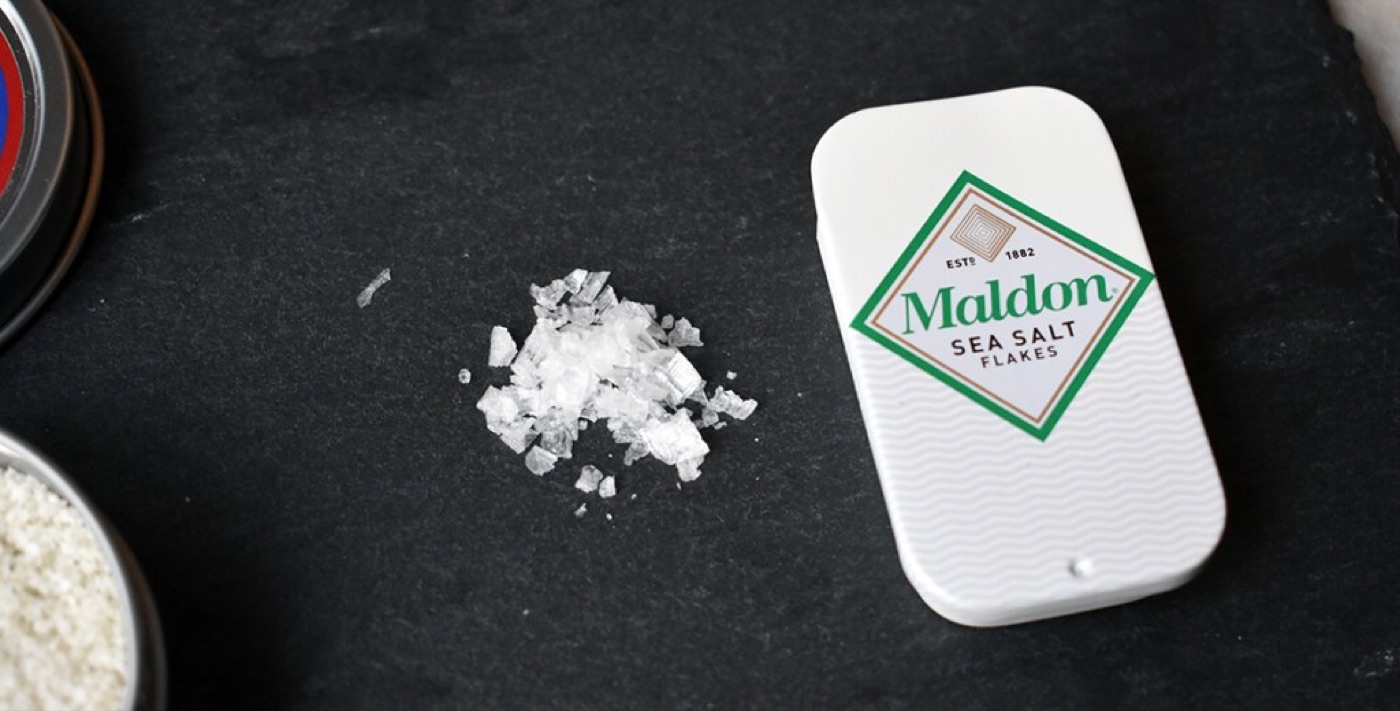
Almost all salt is sodium chloride and almost all of it tastes the same dissolved in water. What separates one salt from another is crystal shape, how fast it dissolves, and what is left in it besides sodium chloride. Those three things matter enormously on a snack and barely at all in a pot of pasta water.
The types, briefly
Table salt. Fine, dense, usually iodised, often with an anti-caking agent. Dissolves instantly. Cheap. Its problem on a snack is that it disappears into the surface and gives you a flat, uniform salinity with no moments.
Kosher salt. Coarser and flakier than table salt, no iodine. The crystals are irregular, which is why cooks like it: you can feel how much you have picked up. Diamond Crystal is markedly less salty by volume than Morton, so recipes that say "kosher salt" without a brand are guessing.
Flaky sea salt. Maldon and its equivalents. Pyramid-shaped hollow crystals that crush between your fingers and sit on the surface rather than dissolving into it. This is the finishing salt.
Fleur de sel. Skimmed off the surface of evaporation ponds. Slightly damp, slightly mineral, more expensive than it needs to be. Genuinely different from Maldon: less crunch, more of a mineral tail.
Rock salt. Mined rather than evaporated. Pink Himalayan is this. The colour is iron oxide and the mineral content is a rounding error on flavour, despite what the packaging suggests.
Why crystal shape is the whole story
Put fine salt on a crisp and every bite tastes the same. Put a flake on a crisp and you get bursts: a moment of intense salinity, then the potato, then another burst.
That variation is what makes something moreish. Uniform seasoning reads as "salty". Uneven seasoning reads as "delicious", which is why finishing salt exists at all.
Flakes also dissolve slower, so the salt lands on your tongue rather than in the food. You perceive more salinity from less salt.
Which to use when
| Job | Salt |
|---|---|
| Seasoning during cooking | Kosher or fine sea salt |
| Finishing a roasted or fried snack | Flaky sea salt |
| Salting a hot chip out of the fryer | Fine salt, so it sticks to the oil |
| On a caramel or chocolate | Flaky, applied after it sets |
| Brining and curing | Whatever is cheapest, by weight |
The one that surprises people is the fryer line. On something hot and oily, fine salt adheres and flakes slide off. Salt the chip fine, then add a flake or two once it has cooled a little.
Measure by weight, not by spoon
Salts differ in density by a factor of two. A teaspoon of table salt and a teaspoon of Maldon are not the same amount of salt, and the difference is enough to ruin something. If a recipe gives grams, use grams.
What is not worth paying for
Smoked salts, mostly. Very few are actually smoked rather than flavoured, and the ones that are lose their aroma within a couple of months of opening.
Coloured salts sold on mineral content. You would need to eat an unhealthy quantity of pink salt for the trace minerals to register nutritionally.
The one thing to change
If you buy one salt on the strength of this piece, buy a box of flaky sea salt and use it only at the end, on things that are already seasoned. It is the cheapest upgrade available to almost any snack you make.
- salt
- seasoning
- fundamentals
- guides
Keep reading
 Guides
The 12 Saltiest Snacks Around the World
From Japan to Mexico, these are the snacks that lean hardest into salt, and what makes each one work.
3 min read
 Guides
Beef Jerky Showdown: Store-Bought vs Homemade
We made four batches and bought six brands. Here is where homemade wins, where it loses, and what it actually costs.
3 min read
 Guides
The Ultimate Guide to Building the Perfect Snack Board
How to build a board people actually finish, using ratios rather than a shopping list.
3 min read
Published Jun 28, 2026 on SaltySnacks.